Antonio Ortuño – La Fila India (Indian File)

9786077351245

My rating:  5 Stars

Every Central American immigrant to the United States has to pass through the entire length of Mexico to get there. On the way, they are routinely subjected to abuse, first by their own countrymen, and then by Mexicans. They are often robbed, extorted, raped, beaten and murdered. The process is highly organized, probably protected by corrupt officials, and decent Mexican citizens apparently turn their heads and look away. We hear about the most egregious cases, like the mass graves found in Tamaulipas a few years ago, but it is a daily occurrence, and the victims are human beings.

This is the subject of Antonio Ortuño’s novel La Fila India (Indian File).

The story focuses on Irma, a government social worker sent to help quietly clean up the political embarrassment of a massacre involving Central American immigrants who were supposedly under the care of an aid organization. Irma arrives in the fictitious southern town of Santa Rosa with her young daughter, prepared to march in “indian file” behind her superiors, following the party line… until the situation gets complicated.

Irma’s job is to expedite compensation of the families of the victims, and repatriation of the survivors. In the course of her work, however, she gets to know a young woman who narrowly escaped the massacre, and begins to wonder why there is no effort to find those responsible for the murders. This concern grows as she develops sympathy for the investigative reporter she is supposed to be discouraging. Dragged along in the whirlwind of the young victim’s desire for revenge, and the reporter’s passion for justice, Irma finds herself at the center of a situation far larger and more dangerous than she could ever have dreamed.

The main characters are vividly imagined, and richly developed. Irma is distracted by caring for her daughter, and carrying on a telephone battle with an angry ex-husband, but finds time for a flirtation with a handsome young man at the office. The husband and the young man develop into complex characters who move the plot and the underlying theme in unexpected ways. Supporting characters include another Central American woman who is subjected to a different kind of abuse, the oddly controlling café owner, the head of the government delegation, and characters from the local underworld. And, of course, the investigative reporter, who has a surprising lack of people skills.

The themes of the book are very powerful. It is largely a story of racism, opportunism and corruption, but it goes much deeper, making us look at our own complexity, and the darkness that lies somewhere in all of us. The desire for truth is balanced with the urge to turn and look away. Finding justice competes with the urge for revenge. The instinct to help the helpless conflicts with a deep-seated inclination to take advantage of them.

Ortuño is a journalist by background, and has turned to fiction more recently. This is a hugely successful merging of journalistic coverage of an important subject into the form of a very entertaining and compelling thriller. The book has received a lot of attention, and has been on everyone’s top ten list for 2013. Absolutely justified, in my opinion.

__________________________________________________________

A fin de repatriar a las víctimas de una masacre, una joven funcionaria es enviada a un pueblo perdido en el sureste de México. Primer error: mudarse allí con su hija de siete años. Segundo: abrirle las puertas de su casa a una sobreviviente. Tercero: averiguar que un grupo criminal se ensaña contra los migrantes centroamericanos. Y cuarto: tratar de resolver una sencilla pregunta: ¿por qué a nadie parece importarle? Compuesta como un caleidoscopio que registra todos los tonos del sarcasmo, La fila india es la novela de madurez de Antonio Ortuño. Una historia apasionante, a medio paso de la novela negra, que nos ofrece un grupo de personajes inolvidables, una prosa difícil de igualar y la mirada de un autor que registra cómo se descomponen las relaciones entre un individuo cualquiera y el país en que vive.

Tlacoyos – La Barbacha, East Los Angeles

IMG_5647-001

We went to La Barbacha for their stunning Hidalgo-style steamed lamb, but for a change, I looked at the rest of the menu, and spotted something I’d never heard of… Tlacoyos. It seems they’re a Mexico City specialty, in which corn masa is stuffed (in this case) with cheese, beans or mashed potato, shaped into a torpedo, and smothered in a rich nopal sauce with crema drizzled on top.

To my taste, they seem to fit into the general category of huaraches, chanclas and sopes – tasty, rich comfort food. We didn’t finish them because we knew our plates of lamb were going to be huge.

Here’s the address and phone number: La Barbacha. 2510 East Cesar Chavez Avenue. East Los Angeles. 323-375-3334

Here’s a piece that NPR did on tlacoyos:

For the last in a summer series of grilled food from around the world, we head to Mexico, where a small doughy treat is found everywhere from street corner grills to high-end restaurants. It’s called a tlacoyo (pronounced tla-COY-yo) and although it may sound novel, it’s an ancient food that’s older than Hernan Cortes.

To taste the best tlacoyos, I was told I had to go to Xochimilco, the sprawling suburb in southern Mexico City. Juana Pina Gonzales has been selling them in the region for 25 years. She only uses blue corn masa — the dough used to make a tortilla — and stuffs the dough with all kinds of fillings, including smashed pinto or fava beans, a potato puree, mushrooms or a light cheese similar to ricotta.

Once filled, she shapes them into a small oval with pointed ends so they look like little footballs, grills them on a hot comal — a smooth round griddle — then wraps them in cloth towels before she puts them in big wicker baskets and heads to the market.

She says she usually sells all 40-50 dozen she’s made in about four hours. While Pina’s are still warm out of the basket, I really wanted one hot off the grill. So I headed to the market’s open food court, where a roving guitarist serenaded customers sitting on rickety benches around a dozen small food stalls. Each is equipped with a large hot grill teaming with all types of Mexican antojitos, or snack food; quesadillas, tacos and of course, hot steamy tlacoyos.

Isabel Salazar Cabrera claims her tlacoyos are the best and original, because her mom was the first to ever sell tlacoyos in Xochimilo. She says they’re the best because of the way she cooks the bean filling, but can’t share the recipe since it’s a family secret.

Once cooked, Salazar slides a hot fried tlacoyo on a plastic plate, and generously tops it with a big spoonful of grilled nopales (catcus slices), chopped onions, cilantro, crumbled fresh cheese and spicy green salsa.

She says tlacoyos have been the favorite food for generations. Her mom told her stories about making the tlacoyos for the farmers who worked the fields or Chinampas of Xochimilco, the floating gardens in the freshwater canals that made this southern stretch of the Mexico City valley so famous.

But Edmundo Escamilla Solis, a historian at the Culinary School of Mexico, says tlacoyos date back even further. He’s seen the small corn masa treats mentioned in the writings of the conquistadors of Mexico in the 16th century.

He says Hernan Cortes and other Spanish chroniclers wrote about Mexico’s indigenous outdoor markets and the stuffed corn masa breads sold in small food shacks. He says back in those days, tlacoyos were not only healthy — pre-Hispanic street vendors never used oil to grill them like now — they were also ideal to eat in a hurry or to take on long trips. He jokes that tlacoyos are the first fast food of the Americas.

While pre-conquest Mexicans may have eaten their tlacoyos in a hurry, chef Martha Ortiz prepares a more leisurely tlacoyo experience at her high-end restaurant in Mexico City’s swanky Polanco district.

“We are going to make it beautiful with a small Mexican fish, sardina, and a beautiful Mexican salad,” she says.

Topped with rich cheese and cilantro, Ortiz says she likes to dress up and surprise her clientele to the food of the streets.

“I love Mexican street food, I love Mexican food,” she says. “For me, it’s a passion; it’s a way of living.”

Clayuda – El Paladar Oaxaqueño food truck – West Los Angeles

IMG_5452-001

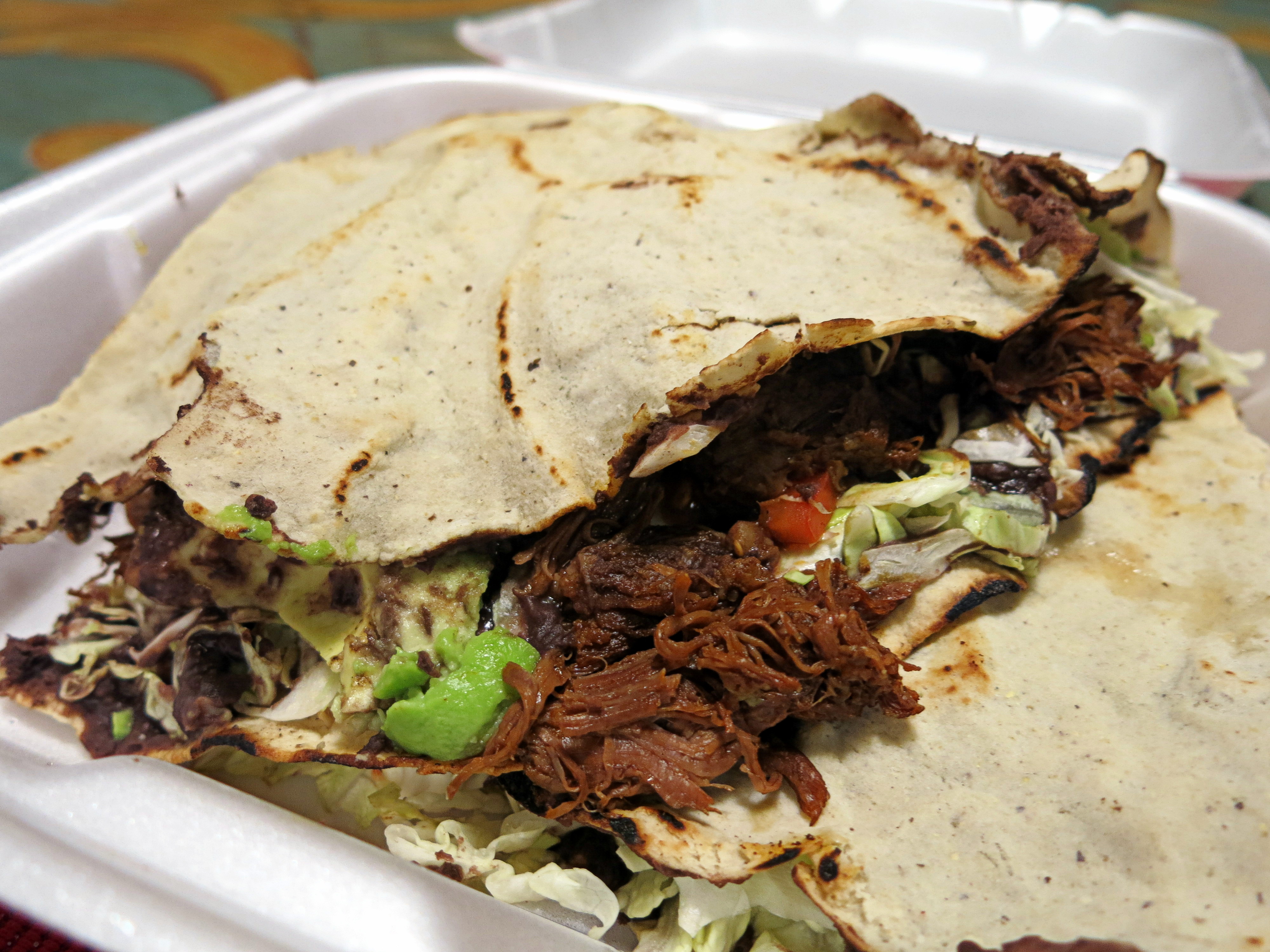
The timing was right when I passed the food truck that parks around the corner in the evenings, so I ordered a Clayuda to go. The truck is called El Paladar Oaxaqueño, and Clayudas (as they are spelled here in Los Angeles) are a distinctly Oaxacan dish… even though the spelling in Oaxaca is Tlayuda.

I’m certain I had a Tlayuda in the main square in Oaxaca several years ago, but my memory isn’t clear enough to make a proper comparison. I do remember it featured fresh guacamole and the Oaxacan string cheese, quesillo. This one had very earthy flavors, including black beans and cooked cabbage and tomato. I went with barbacoa as my meat choice, and that added another delicious earthy layer. Folded into a giant flour tortilla, it was so large that I didn’t even try to finish it – even in the privacy of home.

The real reason I didn’t finish it may be that I misjudged the power of the hot sauce that came with it. It was a cumulative effect, and by the end, I was balanced on that fine line between pleasure and pain.

Rosca de los Reyes

rosca

I was in a Mexican bakery in Los Angeles the other day, and wondered what the big round cake was. It was a Rosca de los Reyes, the traditional cake to celebrate Epiphany on January 6th. According to tradition, that’s the day the 3 wise men arrived in Bethlehem.

rosca (1)

Here’s what Wikipedia says:

Roscón de reyes or rosca de reyes (kings’ ring) is a Spanish and Latin American king’s cake pastry traditionally eaten to celebrate Epiphany.
Although the name indicates that it should be round, the “rosca de reyes” generally has an oval shape due to the need to make cakes larger than 30 cm across for larger parties. Recipes vary from country to country. For decoration, fig fruit, quinces, cherries or dried and candied fruits are used.
It is traditionally eaten on January 6, during the celebration of the “Día de Reyes” (literally “Kings’ Day”), which commemorates the arrival of the three Magi or Wise Men. In most of Spain, Spanish America, and sometimes, Hispanic communities in the United States, this is the day when children traditionally get presents, which are attributed to the Three Wise Men (and not Santa Claus or Father Christmas). In Mexico before children go to bed, they leave their shoes outside filled with hay or dried grass for the animals the Wise Men ride, along with a note.
The tradition of placing a trinket (figurine of the Christ Child) in the cake is very old. The baby Jesus hidden in the bread represents the flight of the Holy Family, fleeing from King Herod’s evil plan to kill all babies that could be the prophesied messiah. Whoever finds the baby Jesus figurine is blessed and must take the figurine to the nearest church on February 2, Candlemas Day (Día de la Candelaria). In the Mexican culture, this person also has to throw a party and provide tamales and atole to the guests. In US communities with large Mexican and Mexican-American populations such as Los Angeles, San Jose, and Chicago, the celebration includes the Mexican hominy stew pozole, which is made for all one’s neighbors.
In Spain, roscones bought in pastry shops have a small figure hidden inside, either of a baby Jesus or little toys for children, as well as the more traditional dry fava bean. Whoever finds the figure is crowned “king” or “queen” of the celebration, whereas whoever finds the bean has to pay for the next year’s roscón or Epiphany party.

n Argentina, there is a similar tradition of eating the rosca on January 6, although no figurine is included. A similar version of the pastry with whole eggs baked on top is served on Easter as rosca de Pascua.
In some places, the roscón de reyes is replaced by panettone, also baked with trinkets inside.
In France, a similar pastry known as a galette de rois (made with puff pastry and almond cream) is eaten on Epiphany, and in the US, the formerly French/Spanish city of New Orleans LA continues this tradition later in the year with their Kings’ Cake, a rich yeasted bread decorated with colored sugar and eaten before Mardi Gras.

Carolina’s and Comedor Guadalajara – Tex-Mex in Phoenix

I’ve had some great Mexican food in Phoenix, so on my recent visit, I thought I’d press my luck, and looked up the most highly-rated places on the Yelp website. My favorite place (which I won’t name here, to prevent any confusion) ranked with 4.3 stars out of 5, so I was excited to find two other places ranking 4.4 and 4.3.

This is a story of surprise and learning, so please don’t think it’s a negative review in any way.

IMG_4494-001

My sister and I drove across town from Scottsdale to somewhere south of downtown Phoenix to try Comedor Guadalajara. It’s a big, friendly place that feels as if it’s been there forever. The menu covered a wide range of meat and seafood dishes, and choosing was difficult. We started with ground beef and mashed potato tacos, which was our first surprise. I’ve become a fan of crispy mashed potato tacos in Los Angeles, but somehow, the addition of ground meat made them taste a little more like something my mother might have made (she was not Mexican.) They were good, but didn’t have the toasty, starchy edge I was expecting.

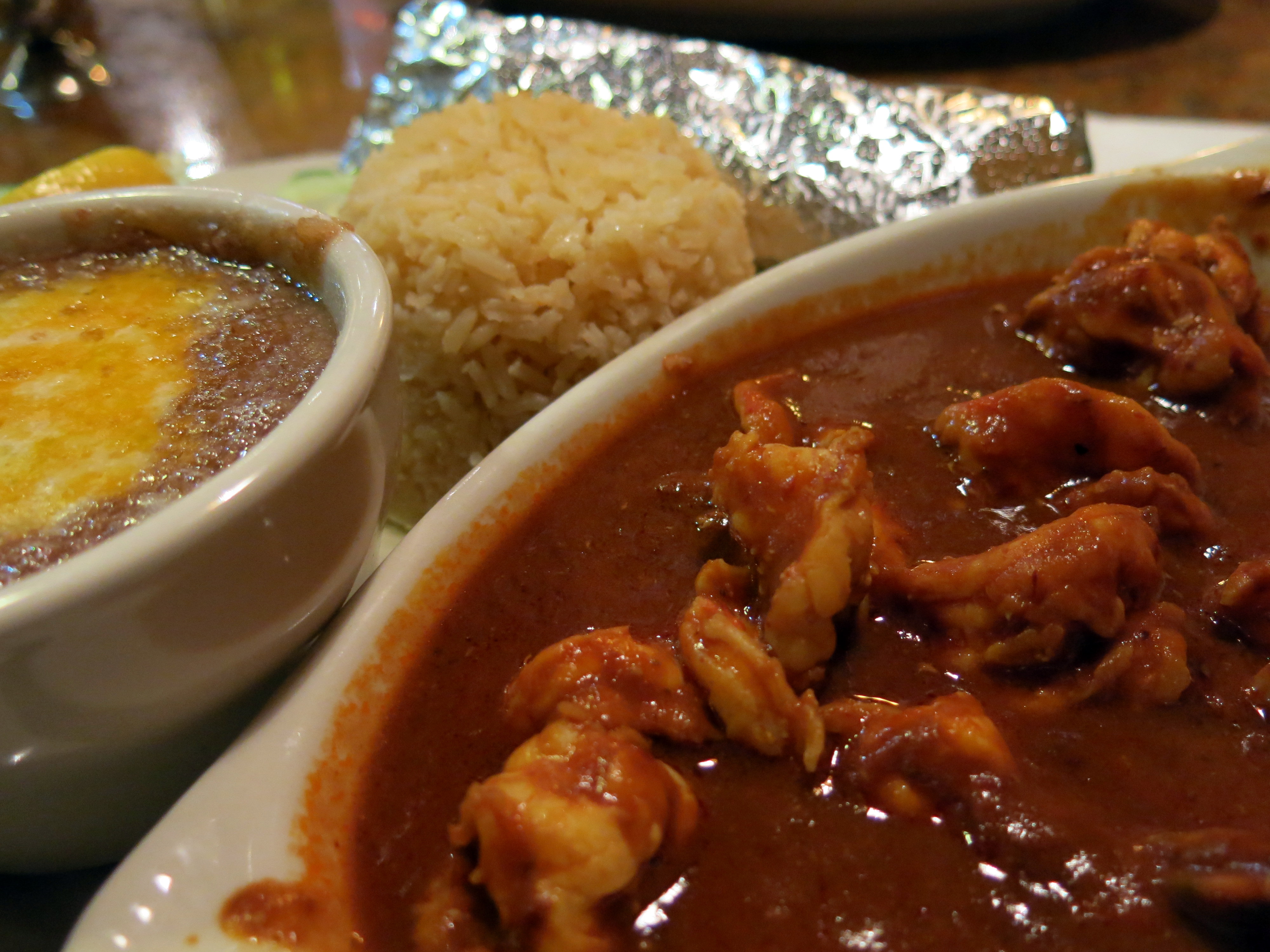
As a main course, I ordered the camarones endiablados, a spicy shrimp dish I’ve had many times in Mexico and Los Angeles. It was nicely presented, with rice and refried beans, and delivered all the chipotle zing that the menu promised… except that it tasted just like barbecue sauce. Leigh ordered chicken enchiladas that were also nicely presented, but in a creamier sauce than expected. Everything was tasty, but we’ve never been served dishes like these in Mexico or Los Angeles. We realized we were eating something similar, but not quite like Mexican food.

IMG_4502-001

The next day, we went to another famous place. For years, my sister has told me about the buttered tortillas at Carolina’s, which is located just a few blocks from Comedor Guadalajara. They turned out to be large flour tortillas, slathered with butter, and folded into an intense, comfort-food ball that will probably be the subject of dreams and fantasies until the next time I’m in Phoenix.The location, however, was a surprise. Leigh had never actually been to Carolina’s, and the free-for-all of the busy down-scale room turned out to be a lot of fun.

IMG_4521-001

The menu was surprisingly limited, with burritos, chimichangas (deep-fried burritos, I was told) and enchiladas being the basic fare. I went for the enchiladas, and Leigh had the chorizo and potato burrito. My enchiladas came in a plastic container, and were covered in a deep brown sauce, melted orange cheese and shredded lettuce. Served with refried beans and rice, they were tasty, but again, unlike anything I’ve had in Mexico or Los Angeles. Leigh’s burrito, however, was wonderful! I’m sure I’ll be going back to Carolina’s.

IMG_4534-001

We spoke with a well-known Mexican chef the following day, asking him just what it was that we had eaten. He was quick to point out (and I agree 100%) that these are good restaurants, but it really isn’t Mexican food, but rather some form of Tex-Mex. Both places have been around for years, and were full of happy diners, so we came away feeling we had learned something valuable.

Liliana V. Blum – No Me Pases de Largo (Don’t Pass Me By)

41TLardhqHL._SY344_BO1,204,203,200_

Short stories are not usually my favorite format. In my experience, either they lack depth, or they’re so abstract that they leave me saying Whaaaaat? Either way, I tend to find them unsatisfying. On the other hand, I’ve loved many of Paul Theroux’s novels, even though they are really short stories addressing specific themes. That’s what Liliana Blum has done in her collection No Me Pases de Largo… and I was very satisfied.

I was curious that the stories are named after Beatles songs, and the cover art features the Fab Four, even though I didn’t see an obvious connection. Later, I was embarrassed to learn that the collection is very appropriately named after the song from Sergeant Pepper “Don’t Pass Me By.” Meanwhile, I found myself singing “All you need is love…” and that made a light bulb turn on in my head. The stories are about love – finding love, losing love, looking for love, running away from love – but these are most definitely not love stories.

The common characters in each of the stories are friends Noelia and Moira. Taking turns at front and center or in the background, we see a complex relationship developed over many years between two very complex 30-something women. This is what really connects the stories, and we see the various ways they support each other and protect themselves through a confrontation with a lover’s wife, the realization that an early love affair was a sham, the loss of “Mister Right” due to a foolish indiscretion, and dealing with the long-term effects of an earlier love affair.

I haven’t read all of Liliana Blum’s work, but this is by far my favorite of her story collections. The good news is that it is in both Spanish and English. I read a couple of the English versions, and found Michael Parker-Stainback’s translation to be fluid and accurate.