
The teachers have been staging massive labor demonstrations in Mexico City. This photo particularly impressed me. Here’s the article in El Universal.

The teachers have been staging massive labor demonstrations in Mexico City. This photo particularly impressed me. Here’s the article in El Universal.
Here’s a link to a great article in the blog: Dave Miller’s Mexico.
Faux Mexican? Five ways to know your combo plate may be wonderful, but not available in Mexico….


Yes, there’s a border between the U.S. and Mexico. And yes, there’s a fence along that border. Here’s what it looks like a couple of hours out of Tijuana.

Believe it or not, Cinco de Mayo is not Mexican Independence Day. It’s September 16th, although the festivities kick off the night before. El Monumento a la Independencia was inaugurated on September 16, 2010, and has been an icon ever since then.
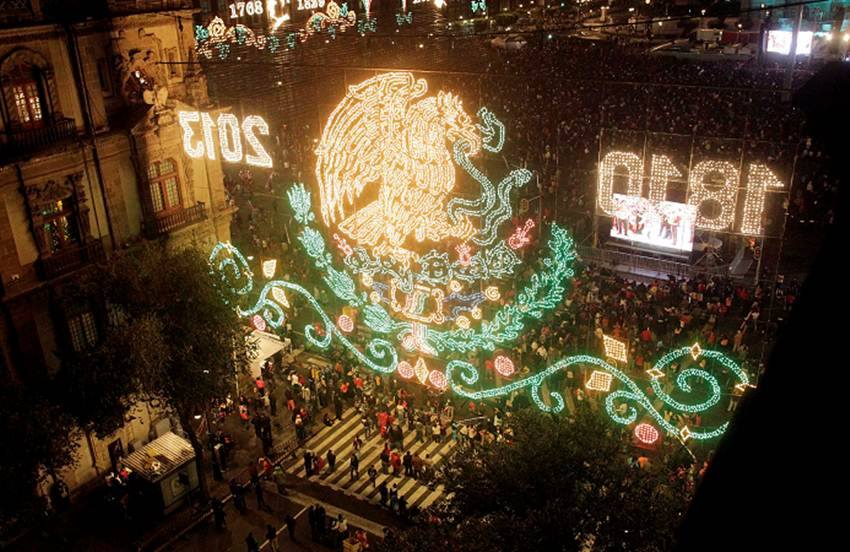
Here’s the story:
In the early nineteenth century, Mexico, with a little influence from the US and France, began talking about a revolt against Spain. Father Miguel Hidalgo from Dolores, Mexico, was a leader of one of the rallying groups. Hidalgo and his officers were planning a revolt for late fall of 1810. The Spanish people found out about the revolt which led the Spanish Government to order the arrest of Hidalgo and his officers. When Hidalgo found out, he called a meeting at his church. He rang the church bell on the night of September 15, 1810 to call his congregation to mass. Here Father Hidalgo rallied the people to fight. He gave the speech which is now known as ‘Grito de Delores’, saying “Viva Mexico” and “Viva la independencia!” These famous words have been remembered and are said each year at the Independence Day celebrations.
Everyone fought together, including the Criollos (wealthy Mexicans of Spanish descent), Mesizos (children born from the marriage of a Spaniard and an Indian), and Indians. Armed with clubs, knives, stone slings, and ancient guns, they fought as they marched to Mexico City. A battle took place in Guanajuato between the Spanish soldiers and Hidalgo’s followers. The army sacked the town, killing the Spaniards. They continued to fight on their way to the capital. When they finally reached Mexico City, the army hesitated before going in to fight and some of them even disserted the army. Before the year was over Father Hidalgo was captured and executed. Some people continued to fight for the cause and Father Hidalgo’s Grito de Delores (Cry of Delores) became the battle cry of the Mexican War of Independence. The people fought for eleven years before they finally won their freedom.
Today Mexican Independence Day is a major celebration in Mexico and is bigger than Cinco de Mayo. It is celebrated with a fiesta (party). The celebrating begins on September 15 (the eve of Independence Day) where crowds of people gather in the zocalos (town meeting place) of cities, towns, and villages. In Mexico City a huge square is decorated with flags, flowers and lights of red, white, and green. People sell confetti, whistles, horns, paper-machete helmets, and toys in the colors of red, white and green. There is also plenty of feasting! When the clock strikes eleven o’clock the crowd gets silent. On the last strike of eleven the president of Mexico steps out on the palace balcony, and rings the historic liberty bell that Father Hidalgo rang to call the people. Then the president gives the Grito de Delores. He shouts “Viva Mexico” “Viva la independencia” and the crowd echoes back. People do this at the same time all across Mexico. While the crowd says this they fill the air with confetti, streamers and hoopla. Castillos explode in showers of red, white, and green. The actual day of September 16 is similar to July Fourth in the US. There are rodeos, parades, bullfights, horseback rider performances and grand feasts. The statues in memory of Father Hidalgo are decorated with red, white, and green flowers. The Mexican Flag is made up of green, white, and red. The green is on the left side of the flag and symbolizes independence. White is the color in the middle of the flag and symbolizes religion. The red is on the right side of the flag and symbolizes union. These colors are used often in decorating for the Mexican Independence Day fiesta.

For years, I’ve kept a photo album on Facebook in which I document wildly dangerous sidewalk conditions in Mexico. These range from open manholes in the middle of busy sidewalks to unsegregated construction sites and situations of general disrepair. Some of the situations are so outrageous by U.S. standards that they are quite entertaining. I generally keep a sharp eye out for danger, and I suppose the local residents do the same… But on a recent trip to Guadalajara, one of the hazards got me … and it wasn’t even an especially obvious one.
Here are a few examples:

Here’s the one that got me – just a raised area in the middle of the asphalt, but the sun was shining in a way that I didn’t see the outline:

And here I am, with a banged-up face, scraped and twisted glasses, and a big scrape on my shoulder:

When I tripped, I took several steps, arms flailing like a windmill, hoping to regain my balance. When I finally, and very publicly fell, several people came to my rescue, and a young woman took me into the bar where she worked, and broke out the first-aid kit… It was embarrassing to explain to the tough-looking customers of the bar that I just tripped, and wasn’t in a fight.
So… watch your step!
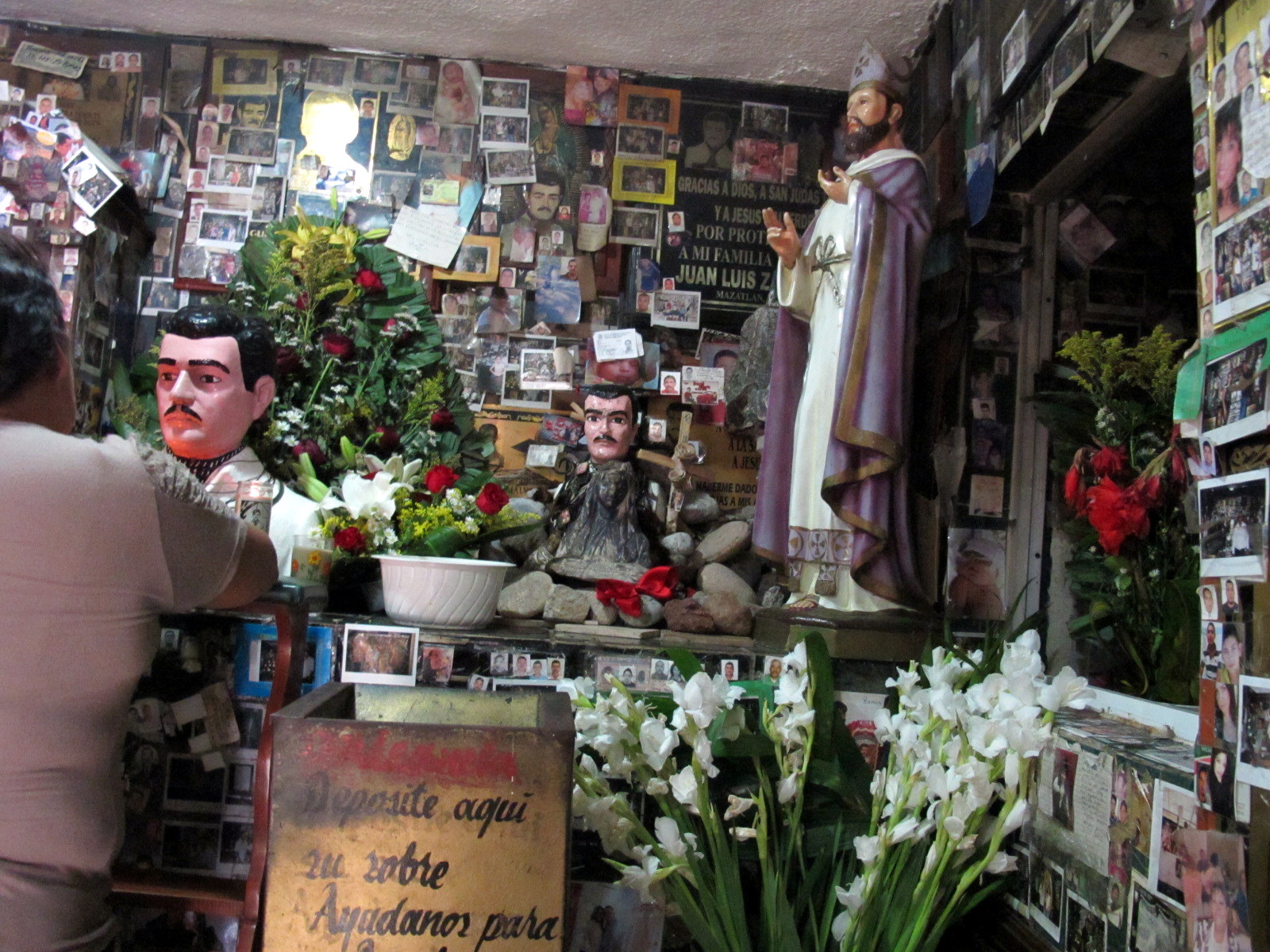
Mexicans will sometimes adopt folk heroes, and raise them to near-saint status. They are not saints recognized by the church, but some people pray to them as if they were. Jesús Malverde is a well-known example from the Sinaloa area. I first became aware of him, and his Culiacán shrine, from Arturo Perez Reverte’s novel La Reina del Sur, which was virtually an homage to Sinaloan writer Elmer Mendoza.
Sinaloa is the historic center of the Mexican drug trade, and Malverde has become especially popular among traffickers and traders in the area. The walls of the chapel are covered with prayers for future transactions, and thanks for the success of previous endeavors.
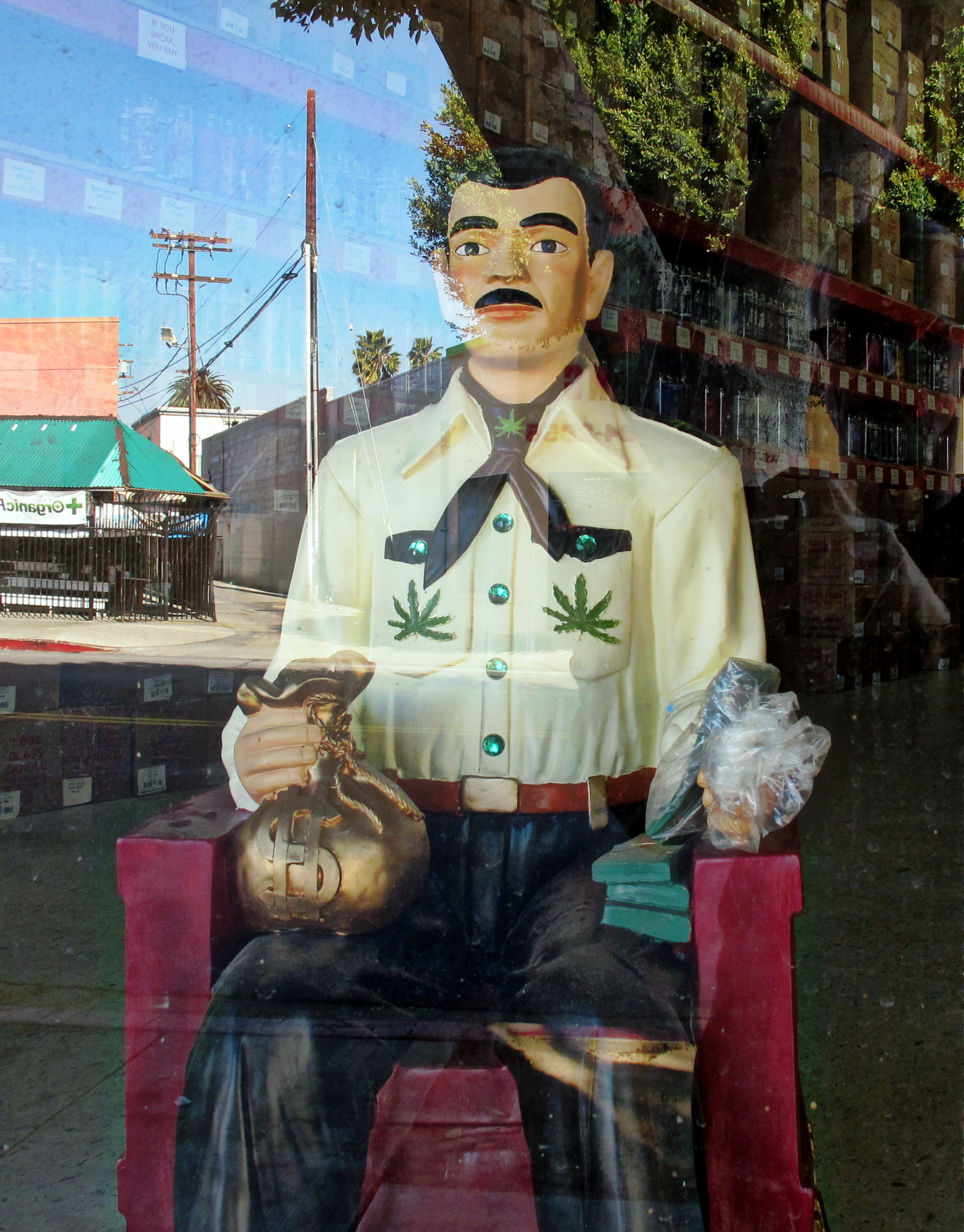
I visited the Malverde chapel on my recent visit to Culiacán, and here are some of the photos I took. I’m also including a picture of a Malverde statue that I took through a store window in Los Angeles. Appropriately, he is holding a big bag of marijuana, and a fist full of dollars.


Here’s what Wikipedia says:
Jesús Malverde, sometimes known as the “generous bandit”, “angel of the poor”,[1] or the “narco-saint”, is a folklore hero in the Mexican state of Sinaloa. He is celebrated as a folk saint by some in Mexico and the United States, particularly among those involved in drug trafficking.[2] He is not recognized as a saint by the Roman Catholic Church.
The existence of Malverde a.k.a. ‘El Rey de Sinaloa’ is not historically verified,[3] but according to local legends he was a bandit killed by the authorities on May 3, 1909. Accounts of his life vary – sometimes he was a railway worker, while others claim he was a construction worker. There is also no agreement on the way he died, being hanged or shot.
Since Malverde’s supposed death, he has earned a Robin Hood-type image, making him popular among Sinaloa’s poor highland residents. The outlaw image has caused him to be adopted as the “patron saint” of the region’s illegal drug trade, and the press have thus dubbed him “the narco-saint.”[4] However, his intercession is also sought by those with troubles of various kinds, and a number of supposed miracles have been locally attributed to him, including personal healings and blessings.
A series of three Spanish-language films have been released under the titles Jesus Malverde, Jesus Malverde II: La Mafia de Sinaloa, and Jesus Malverde III: Infierno en Los Angeles. They all feature tales of contemporary Mexican drug trafficking into California, with strong musical interludes during which the gangsters are shown at home being serenaded by Sinaloan accordion-led Norteño bands singing narcocorridos.
Spiritual supplies featuring the visage of Jesús Malverde are available in the United States as well as in Mexico. They include candles, anointing oils, incense, sachet powders, bath crystals, soap and lithographed prints suitable for framing.
“Always & Forever” is a dramatic stageplay that features Malverde as a prominent character. The play examines various aspects of Mexican-American culture, such as quinceañeras, banda music, and premiered in April 2007 at the Watts Village Theater Company in the Watts neighborhood of Los Angeles. A revival production opened in May 2009 at Casa 0101 Theatre in another Los Angeles neighborhood, Boyle Heights.
A brewery in Guadalajara introduced a new beer, named Malverde, into the Northern Mexico market in late 2007.[5]
A Malverde bust is featured in AMC’s Breaking Bad television series, in the episode entitled “Negro Y Azul”.
A popular Mexican hip-hop artist performs under the pseudonym Jesús Malverde.
Several important scenes of the telenovela La Reina del Sur take place at his chapel in Culiacán and Malverde’s name is mentioned many times during the show.
Mexican radio station Ibero 90.9 has a series called 6 Tracks, in which guests are asked to name 6 songs that have been important in their lives. This is one of the songs selected by Bernardo Fernández, Bef, illustrator, graphic designer and author (see my review of his wonderful novel Ojos de Lagarto)
Here’s the link to see the rest of the tracks he selected:
http://ibero909.fm/bernardo-bef-fernandez-escritor-e-ilustrador-en6tracks/

When is the last time you saw a Woolworth store? They’re still thriving in Mexico. In Acapulco a few years ago, I saw Woolworth stand-alone restaurants that appeared to be competitors of VIPS. Not surprising, given that Woolworth was the largest restauranteur in the U.S. until it was overtaken by McDonald’s.
The stores have a special meaning for me because I worked for the company for 15 years in Canada and the U.S., and in 1992, I was offered the position of Chief Financial Officer of the Mexican company. Instead, I lost all my money producing independent films.
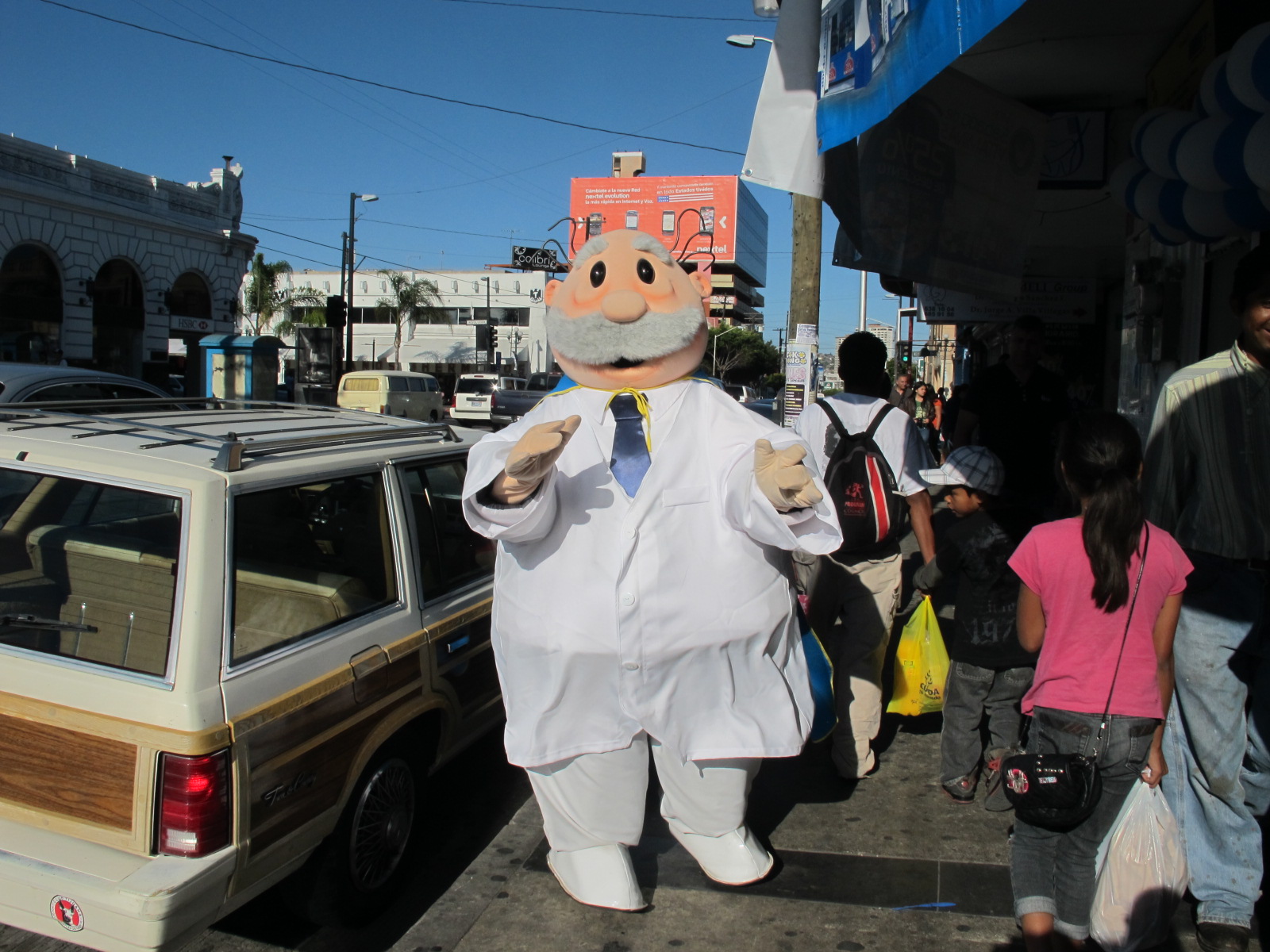
Everywhere you go in Mexico, there will be a Doctor Simi dancing wildly in front of a Farmácias Similares outlet. They’re a huge chain of drugstores that provide medical services, and sell generic versions of most drugs. In Nuevo León a few years ago, I had some sort of insect bite on my foot that threatened to ruin my trip. A visit with a nice doctor, and a prescription from the drug store cost me slightly over $10, and the trip lasted another 3 weeks.
I’m always happy to see the dancing doctor.
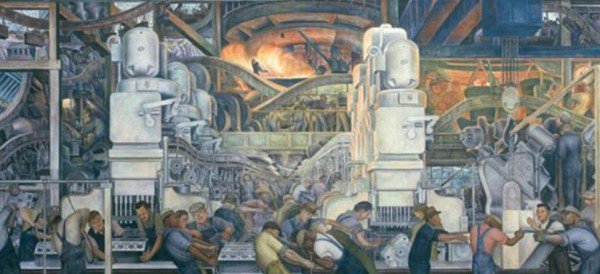
There are 12 Diego Rivera murals in the Detroit Institute of Art. They were commissioned by Edsel Ford in 1932, when he was president of the city’s Arts Commission. There is concern that Detroit’s recent bankruptcy will reduce funding for maintenace of these important works.
Here’s the link to the Aristegui Noticias article: http://aristeguinoticias.com/2507/kiosko/n-peligro-obras-de/
 Bruce Critchley's Mexico Here and There