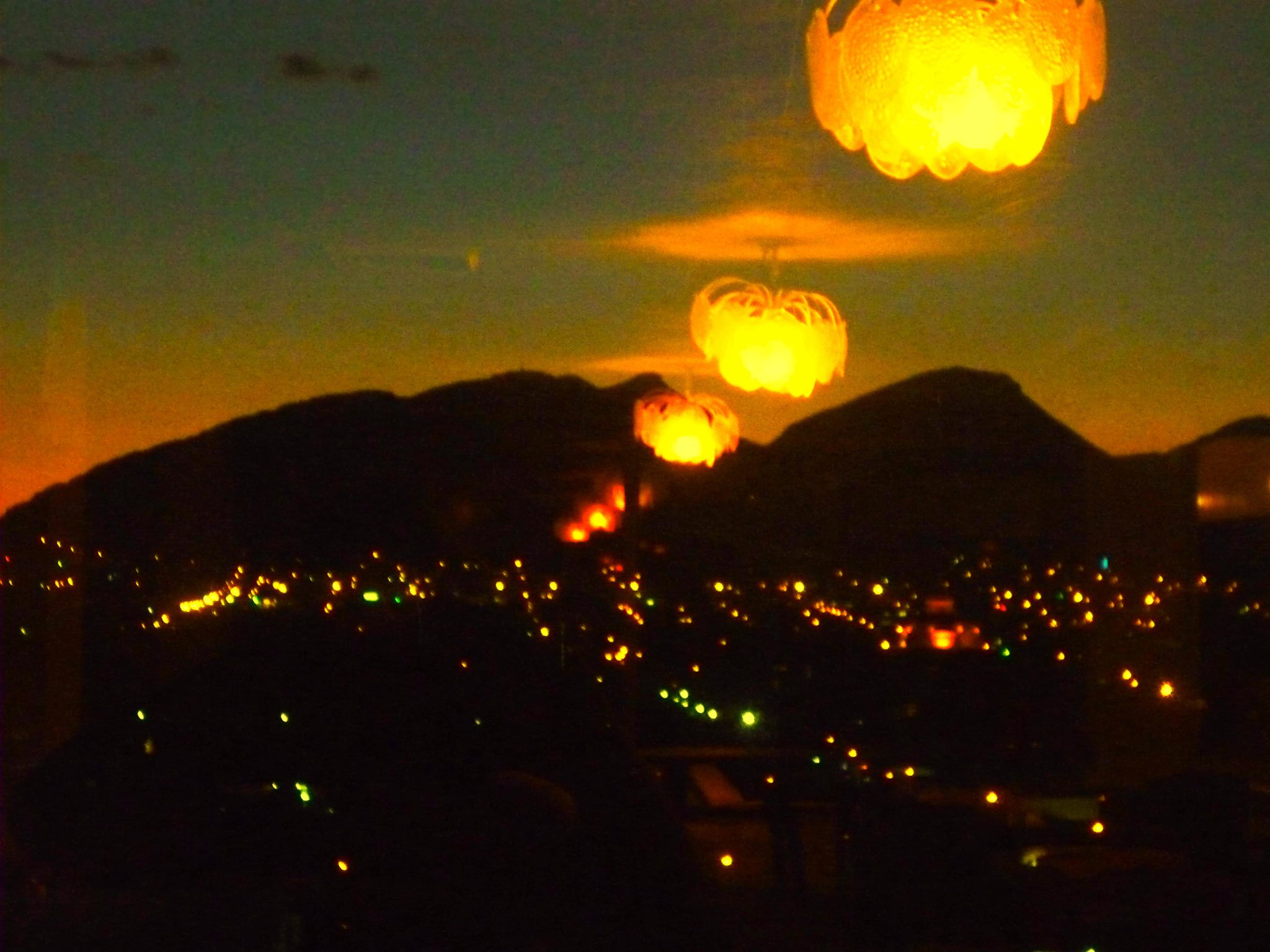
A beautiful shot of Saltillo taken from the restaurant of the Hotel San Jorge. May, 2012. Thanks to Marlén Curiel-Ferman.

A beautiful shot of Saltillo taken from the restaurant of the Hotel San Jorge. May, 2012. Thanks to Marlén Curiel-Ferman.

There are a lot of great meat experiences in Los Angeles, ranging from Argentinian steaks to Shanghai style pork shanks, but I’ve just added a new favorite to my list.
El Borrego de Oro serves lamb barbacoa style, in which the whole lamb is steamed in an underground oven, covered with maguey cactus leaves. The result is a remarkably flavorful meat so soft that it falls off the bone. This is the style that has been perfected in the Mexican state of Hidalgo over many generations. They sell barbacoa by the pound, and will even cook an entire lamb for you by special order, but I went for the tacos… despite my good intentions, I can only eat so much.
The meat is cooked essentially without spices, to preserve the rich meaty flavor, so I was slightly surprised to receive two tortillas, each with a generously large, but unadorned piece of meat on top. Accompanied by cilantro, chopped onion and lime wedges, all I needed was a liberal splash of smoky, spicy chile sauce for a perfect experience.
With all 3 locations in East LA, I had to drive for this experience… I’m looking forward to doing it often in the future.
Here’s the website: http://borregodeoro.com/

My rating: 4 Stars
José Mariano Leyva, yes the same name as the author, is a cynical young man who barely goes through the motions of having friends and personal interactions. When four of his “friends” separately find themselves at a crisis point in their lives, they each ask José Mariano if they can use his house in Cuernavaca as a quiet refuge in which to sort out their problems. He says yes to all of them, taking pleasure in their surprise at finding themselves at a gathering of “Imbéciles Anónimos,” which doesn’t need much translation.
When one member of the group is arrested on the way to Cuernavaca for carrying 3 grams of cocaine, he falls into the hands of a corrupt policeman. Personally familiar with the Leyva family, the policeman learns about the meeting of the four burn-outs, and shows up at the house to enforce his extortion and to generally terrorize the group. This builds to a brutal climax that would have been the end of many other books, but in this case just sets in motion the real story.
The real story involves the pressures of being 30 years old, our parents’ impact on how we live our lives, our ability to change the course of our lives if we really want to, the revolution in Guerrero in the 1970s, the bitter/sweetness of revenge, and our vulnerability, no matter how careful we are, to people with evil intentions.
This is an exciting novel that covers a surprisingly wide range of themes, and succeeds on every level. An award-winning book, it won the “Premio Bellas Artes de Novela José Rubén Romero 2009.” Highly justified.
_______________________
Imagínate una casa en Cuernavaca, en medio de la nada, que pides prestada a un amigo para exorcizar tus demonios en soledad. Imagina que llegas y, como por arte de magia, va formándose un grupo de imbéciles a los que en tu vida has visto, que aparecen ahí con la misma intención que tú. Imagina entonces un crimen inesperado, del que te vuelves cómplice sin comprender cómo es que de ser un desgraciado te has convertido, de repente, en un asesino. A partir de ese momento, sobra decir que nada volverá a ser igual. Imbéciles Anónimos es una novela de euforia prolongada por el beat de un DJ. Pero también es una explosión de rabia nihilista como distintivo generacional. En su primera novela, José Mariano Leyva se perfila como un exquisito narrador kamikaze que con la narcosis, el sexo sin profilaxis, la música electrónica y el gadget tecnológico como fuselaje, estalla contra el aquí y el ahora de una sociedad predecible y aburrida. El impulso vital de un grupo de amigos ‘hermosos y malditos’, (diría Scott Fitzgerald) es el combustible de esta historia.

I’ll admit it – I’m fascinated by the huge volcano 40 kilometers from Mexico City airport, near Puebla. In this video, a father and son team climbed to the lip of the volcano to film it.
Here’s the link to El Universal’s website: http://www.eluniversaltv.com.mx/videos/v_8f5d06cc000f4d098d485440f627aeac.html


Carnitas Uruapan is famous for its meats, and especially its carnitas. That’s why I was surprised when I visited their location at the East LA Meets Napa event last week. Every participating restaurant chose a signature dish to serve, and Carnitas Uruapan chose… baked goods.
I had been eating enthusiastically all evening, so I just asked to try the coconut cookie, and I couldn’t resist the heart-shaped peanut butter cookie. Both were delicious, with the natural coconut and rich peanut butter flavors highlighted by just enough sweetness, and perfectly executed textures.
My little surprise, though, was the Conchita that had been slipped into my bag. No great expert on Mexican baked goods, I tend to think of a concha as being a bit bigger, kind of dry, and served at breakfast in the hotels I visit. But this was something very different – absolutely the best version I have ever eaten. It was light and sweet, more like a beignet, even dusted with sugar in the same way.
Thank you to Carnitas Uruapan for this nice experience.
Here’s the website: http://www.carnitasuruapan.com


Several years ago, when I learned that Chichén Itzá served Yucatán style venison tacos, I dropped everything and went to try them. They don’t seem to be on the menu any more, but they were absolutely delicious. Since then, I have been back many times to their South Grand Avenue restaurant, as well as to the short-lived MacArthur Park location. I’ve had perfectly executed red and green pipiáns, Yucatán specialty poc chuc and many other wonderful dishes. There’s always a feeling of anticipation while driving there, because, out of character for me, I haven’t settled on a single favorite dish.
Last Friday, I had the pleasure of meeting Gilberto and Gilberto (yes, two Gilbertos) at the East LA Meets Napa fund-raising event for AltaMed. Each of the participating restaurants presented a specialty dish for the sophisticated crowd of over 1,000 people, and Chichén Itzá’s mesquite grilled shrimp with a habanero cream sauce was a stand-out success. Served on a bed of julienne zucchini, the distinctive flavors of the shrimp and mesquite were beautifully balanced by a flavorful cream sauce with just enough habanero heat to add a whole new layer to the experience.
A consistently good restaurant, run by really nice people… what more can we ask for?
Here’s the website: http://www.chichenitzarestaurant.com/

Here are the 6 best selling books in Mexico so far this year. I found the list rather interesting.
Inferno – Dan Brown
Perdida (Gone Girl) – Gillian Flynn
Bajo la misma estrella (The Fault in Our Stars) – John Green
Rayuela (Hopscotch) – Julio Cortázar
Las ventajas de ser invisible – Stephen Chbosky
Pequeño cerdo capitalista – Sofía Macías
I’ve only read Gone Girl, which I adored, and Hopscotch, which seems to have remained a bestseller at least since I read it in college. 50 Shades of Gray apparently started the year with strong sales, but then dropped off.
Here’s the link: http://www.sopitas.com/site/236934-los-6-libros-mas-vendidos-en-mexico-en-lo-que-va-del-ano/

At the AltaMed event last Friday night, I had the pleasure of meeting Milan from the great downtown LA club The Conga Room.He made me one of his signature cocktails, the Espino.
Made from pomegranate and lime juice, and a jalapeño reduction, it was a wonderful surprise. The pomegranate and lime balanced each other perfectly, and the jalapeño not only added a fruity richness, but also a comfortingly warm finish. I had the alcohol-free version, so I’m pretty sure it only gets better when served exactly the way Milan designed it.
Here’s the website: http://www.congaroom.com/

Guelaguetza starts on Monday. A major pre-hispanic festival in the southern state of Oaxaca, Wikipedia has quite a lot to say about it:
The Guelaguetza, or Los lunes del cerro (Mondays on the Hill) is an annual indigenous cultural event in Mexico that takes place in the city of Oaxaca, capital of the state of Oaxaca, as well as in nearby villages. The celebration centers on traditional dancing in costume in groups, often gender-separated groups, as is traditional, and includes parades complete with indigenous walking bands, native food, and statewide artisanal crafts such as prehispanic-style textiles. Each costume (traje) and dance usually has a local indigenous historical and cultural meaning. Although the celebration is now an important tourist attraction, it also retains deep cultural importance for the peoples of the state and is important for the continuing survival of these cultures.
Oaxaca has a large native indigenous population, well over 50 percent of the population, compared to 20 percent for Mexico as a whole (depending on systems of classification). Indigenous culture in Oaxaca remains strong, with over 300,000 people in the state who are monolingual in a wide variety of native indigenous languages and many others who are bilingual in Spanish, or follow a predominantly indigenous lifestyle. Unlike nearby Yucatán also located in the Mexican Southeast, where the indigenous culture consists of closely related groups of the same culture (Mayans), the indigenous people in Oaxaca are from many different cultures. Zapotec and Mixtec are the two biggest ethnic groups in terms of population and area, but there are also a great number of other groups, and all have their own unique traditions and speak diverse, mutually unintelligible languages. The Guelaguetza celebration dates back long before the arrival of the Spanish and remains a defining characteristic of Oaxacan culture.[1] Its origins and traditions come from prehispanic earth-based religious celebrations related to the worship of corn and the corn god.[2] In contemporary Oaxaca, indigenous communities from within the state gather at the Guelaguetza to present their native culture, mainly in the form of music, costumes, dances, and food. It is the most famous indigenous gathering of its kind in Mexico.[2]Like many indigenous traditions in Mexico, this festival was adapted to and mixed with Christian traditions after the Spanish conquest of the area. The human sacrifice of a virgin slave girl[citation needed] was eliminated from the event, and the Guelaguetza instead became mixed into a celebration honoring Our Lady of Mount Carmel (Virgen del Carmen), emphasizing marianism combined with the surviving beliefs. In the early part of the 20th century, after a severe earthquake in the 1920s that destroyed most of the city, the festival was re-organized as a statewide cultural event to rebuild the morale of the peoples of Oaxaca “La Guelaguetza de la Raza”.[2] It began to take on a more modern form as a display of each peoples/region’s unique dance, and also started to become more of a show than a spontaneous festival. In the 1970s a stadium dedicated to the Guelaguetza was built on a prominent place on Fortin Hill in the center of the city. National and international tourism became increasingly popular when the ancient city of Oaxaca became a UNESCO world heritage city in 1987 and when a modern limited access highway was built to the city in November 1994. Before the highway, transportation was so slow that it was virtually impossible to journey through the rugged, often remote, mountainous high-altitude terrain to reach Oaxaca City from other cities such as Mexico City for a weekend trip to the Guelaguetza.
The celebration takes place on consecutive Mondays at the end of July in towns around the state and in the capital city’s open-air amphitheater built into the “Cerro del Fortín”, a hill that overlooks central Oaxaca City. The word Guelaguetza comes from the Zapotec language and is usually interpreted as the “reciprocal exchanges of gifts and services” in keeping with the importance in indigenous cultures of sharing, reciprocity, and extended community.[1] The Guelaguetza celebration also includes many other side events, including a performance of “Princess Donaji”, an epic prehispanic theatrical presentation performed the day before the Guelaguetza itself begins.
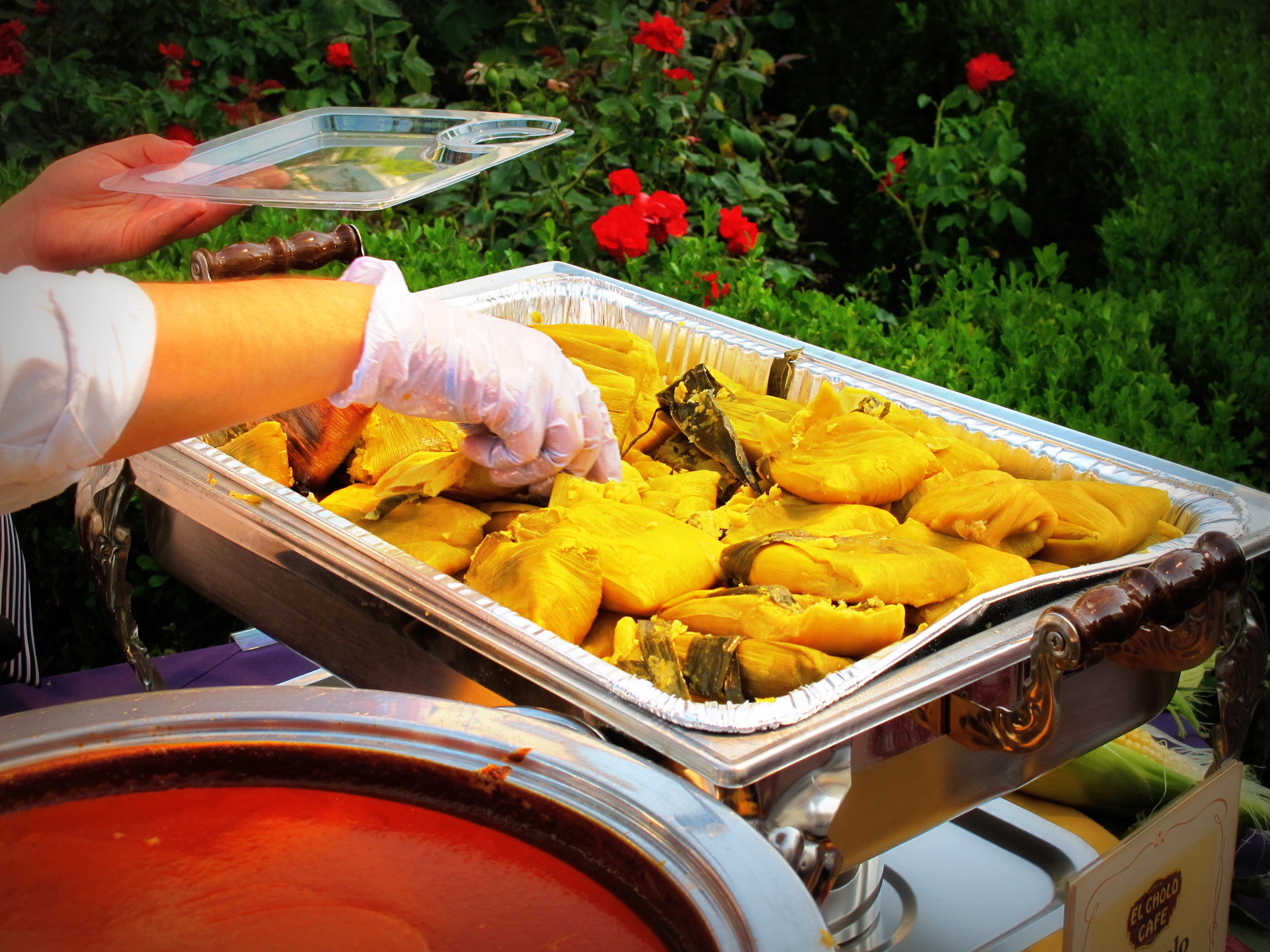
It’s been a long time since I’ve been to El Cholo, which has been a fixture in Los Angeles since 1923. I recently posted an article in which El Cholo was cited as being the first LA restaurant to serve a burrito – that’s the kind of history they bring to the table. They have branches around town, but the location I always think of is the original on Western Avenue south of Olympic.
El Cholo was a participant in the wonderful fund-raising event for AltaMed, held in the courtyard of Union Station, so I was able to reacquaint myself. Each of the restaurants that came to the event selected a featured item, and El Cholo chose to serve Green Corn Tamales with a delicious Mole Poblano. The tamales were made with a rich, soft masa, and were sweetened and textured with whole kernels of corn, and a secret (to me) ingredient that gave them a creamy, almost cheesy finish. The mole poblano, with its sweet/smoky/spicy flavor was the perfect accompaniment.
I’m sure I’ll be going to El Cholo in the near future to see what else is on the menu.
Here’s the website: http://www.elcholo.com/
 Bruce Critchley's Mexico Here and There